Single-tooth implant1 missing tooth
One implant and a porcelain crown are placed in the gap; neighboring teeth are never touched.
A dental implant is a titanium artificial tooth root placed into the jawbone to replace a missing tooth. It leaves neighboring teeth untouched, looks and feels like a natural tooth, and provides a permanent fixed tooth that can last a lifetime. At ÖzbuDent, your implant treatment is planned individually using digital 3D CT imaging and expert dentist consultation.
A dental implant is a biocompatible titanium screw placed into the jawbone in place of a lost tooth root. It fuses biologically with the bone (osseointegration), and when topped with a porcelain crown it becomes virtually indistinguishable from a natural tooth — and just as permanent.
Unlike a dental bridge, an implant never requires cutting down the healthy neighboring teeth; each missing tooth is completed independently with its own root. An implant tooth consists of three parts:
The titanium screw placed into the jawbone. It takes over the function of the natural tooth root, fusing with the bone to create a stable foundation.
The connector that joins the implant body to the crown above it. It is attached to the implant once healing is complete.
The ceramic/zirconium crown visible in the mouth, custom-made to match the color and shape of your teeth. It blends seamlessly with your natural smile.
Dental implants are today's gold standard for replacing missing teeth. Key differences compared to bridges and removable dentures:
Unlike a bridge, the healthy teeth on either side do not need to be cut down; the missing tooth is completed independently with its own root.
The artificial root stimulates the bone just like a natural tooth, halting the bone resorption that begins after tooth loss.
Because it is fixed, it never shifts; chewing strength, speech, and aesthetics are as close to a natural tooth as possible.
With proper care, an implant can last a lifetime; over the long term it is more economical than frequently replaced dentures.
Almost anyone who is in good general health and has a fully developed jawbone can receive a dental implant. Candidacy is assessed through an examination, digital CT imaging, and — if needed — lab results.
Implants can be placed in anyone 18 years or older whose jawbone has finished developing; there is no upper age limit. Implants can be safely placed in older patients as long as general health permits.
Well-controlled conditions such as diabetes or hypertension are not a barrier. Your dentist will plan treatment taking your current medications and health values into account.
Areas with reduced bone volume can be strengthened with bone grafting; in cases of advanced resorption, zygomatic implants make fixed teeth possible without grafting.
Smoking can slow osseointegration; it is not an absolute barrier, but reducing or quitting — especially during the healing period — noticeably improves outcomes.
From a single missing tooth to complete arch tooth loss, there is an implant-based solution for every situation. The best option for you will be determined after your examination and CT scan.
One implant and a porcelain crown are placed in the gap; neighboring teeth are never touched.
When multiple adjacent teeth are missing, a fixed bridge is placed on a small number of implants instead of one implant per tooth.
When no teeth remain in an arch, 4 or 6 implants support a full fixed arch; in most cases a temporary fixed set is fitted the same day.
Learn moreWhen the upper jaw has severe bone resorption, specially elongated implants anchored in the cheekbone provide fixed teeth without the need for bone grafting.
Learn moreImplant treatment progresses through clear stages from planning to the permanent tooth; you will know exactly what to expect at every step.
An oral examination and digital 3D CT scan measure your bone volume; the implant's position, length, and brand are planned with precision.
Under local anesthesia, the titanium implant is placed into the jawbone in a procedure that typically takes 15–30 minutes and is virtually pain-free.
An average of 2–3 months is allowed for the implant to fuse with the bone; a temporary tooth is used during this time if needed.
Once fusion is complete, the abutment is attached, a digital impression is taken, and the crown is trialed for color and shape before final placement.
The porcelain crown is secured; with regular check-ups and proper oral hygiene your implant will serve you reliably for many years to come.
Aftercare is the most important factor determining how long your implant lasts. What to keep in mind after the procedure and tips for long-term success:
Apply a cold compress to the area from the outside; avoid hot food and drinks, spitting, and rinsing your mouth.
Eat soft foods and avoid chewing on the implant side; take any prescribed medications as directed by your dentist.
Brushing twice a day along with an interdental brush and dental floss prevents inflammation around the implant (peri-implantitis).
A dentist visit and professional cleaning every 6 months keeps your implant healthy for life.
Let us build together the implant plan best suited to your jawbone and goals. Accurate diagnosis with digital CT imaging, and a comfortable treatment journey with flexible payment options.
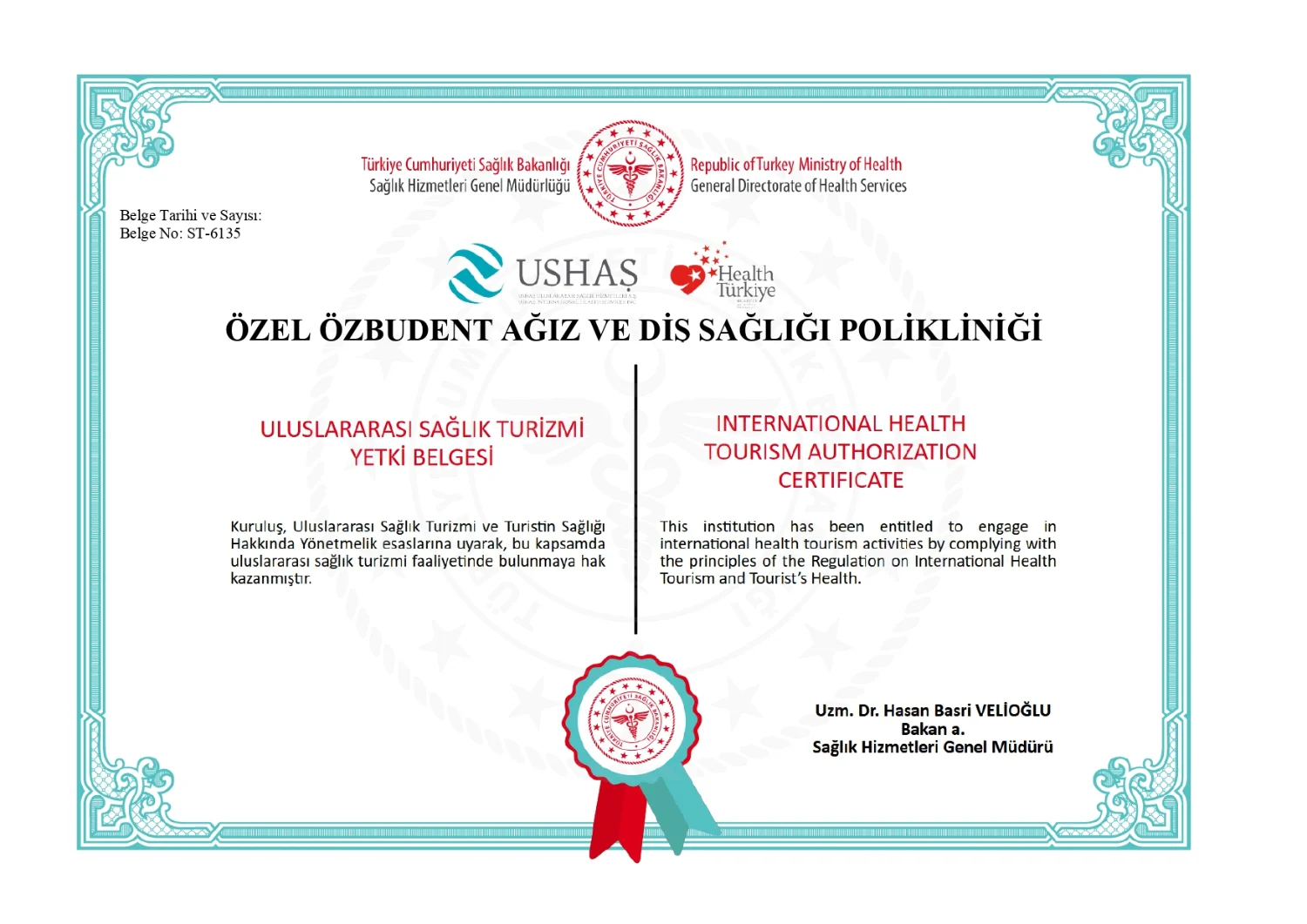

Özel ÖzbuDent Oral and Dental Health Polyclinic holds the International Health Tourism Authorization Certificate, issued by the Republic of Türkiye Ministry of Health under certificate number ST-6135. This certificate shows that our clinic meets the service and quality standards of international health tourism legislation and is officially authorized to serve patients coming from abroad.
Within the HealthTürkiye program, we accompany our international patients end to end — from examination to treatment planning — in implants, cosmetic dentistry and all oral and dental health treatments. Please contact us for detailed information.

You are currently outside our WhatsApp support hours. If you have an emergency, please call us — our clinics are open every day until 03:00. You can still leave your message; we'll get back to you as soon as the line opens.