No bone grafting neededGraft-Free
Because the implant is anchored in the dense cheekbone rather than the resorbed jawbone, there is no need for grafting, sinus lifting, or months of waiting for bone to regenerate.
Zygomatic implants are specially designed long implants placed into the cheekbone (zygoma) rather than the jawbone — used when the upper jaw has experienced severe bone resorption. No bone grafting or sinus lift is required, and in most cases you leave the clinic the same day with temporary fixed teeth. They are a proven, effective solution for patients who have been told "your bone is insufficient for implants."
When the upper jaw has been edentulous for a long time, bone gradually resorbs and there may no longer be sufficient volume for conventional implants. Zygomatic implants are designed for exactly this situation; they are used exclusively in the upper jaw, and suitability is confirmed with digital 3D CT imaging.
Patients whose upper jawbone has resorbed to the point where it can no longer support conventional implants, due to prolonged tooth loss or denture wear.
Patients who have been declined for implant treatment due to insufficient bone, or whose previous implants failed.
Patients who do not want bone grafting and months of waiting for ossification, and prefer a single-procedure result.
Upper-jaw patients unsatisfied with loose, uncomfortable full dentures who want to switch to fixed teeth.
The cheekbone is dense and unaffected by tooth loss — giving zygomatic implants both speed and reliability.
Because the implant is anchored in the dense cheekbone rather than the resorbed jawbone, there is no need for grafting, sinus lifting, or months of waiting for bone to regenerate.
In most cases, temporary fixed teeth are fitted on the same day as the procedure — no palate coverage, allowing you to eat and speak with confidence right away.
Instead of the multi-stage surgeries required with grafted approaches, one procedure is sufficient — cutting total treatment time by months.
The dense structure of the cheekbone provides strong retention for the implant; scientific studies consistently report long-term success rates above 95%.
Both are titanium implants; the difference lies in the bone they anchor into and how each approach addresses bone resorption.
Conventional implants are placed in the jawbone; zygomatic implants, with their longer body, are anchored in the cheekbone (zygoma).
Conventional implants may first require grafting or a sinus lift; zygomatic implants proceed graft-free, directly into the solid cheekbone despite jaw resorption.
Grafted conventional treatment can take 6–12 months; with zygomatic implants, temporary fixed teeth are placed the same day in most cases, and the permanent prosthesis is completed in approximately 3–4 months.
Zygomatic implants are used exclusively in the upper jaw; they are frequently planned alongside the All-on-Four concept. Conventional implants are used for lower jaw deficiencies.
Our experienced implant surgeons are with you at every step — from digital planning to your permanent teeth.
An intraoral examination and digital 3D CT scan are used to assess the structure of your upper jaw and cheekbone in detail, confirming your suitability for treatment.
The number of implants, their angles, and the prosthesis design are planned digitally; anesthesia preference (local or sedation) is decided together with your dentist.
The zygomatic implants — combined with conventional implants in the anterior region when needed — are placed in a single session; temporary fixed teeth are fitted the same day in most cases.
After an average healing period of 3–4 months, your permanent teeth are fitted; regular check-ups ensure lasting results.
Let our experienced implant surgeons evaluate your suitability for zygomatic implants with a digital 3D CT scan, and plan a comfortable treatment journey with flexible payment options.
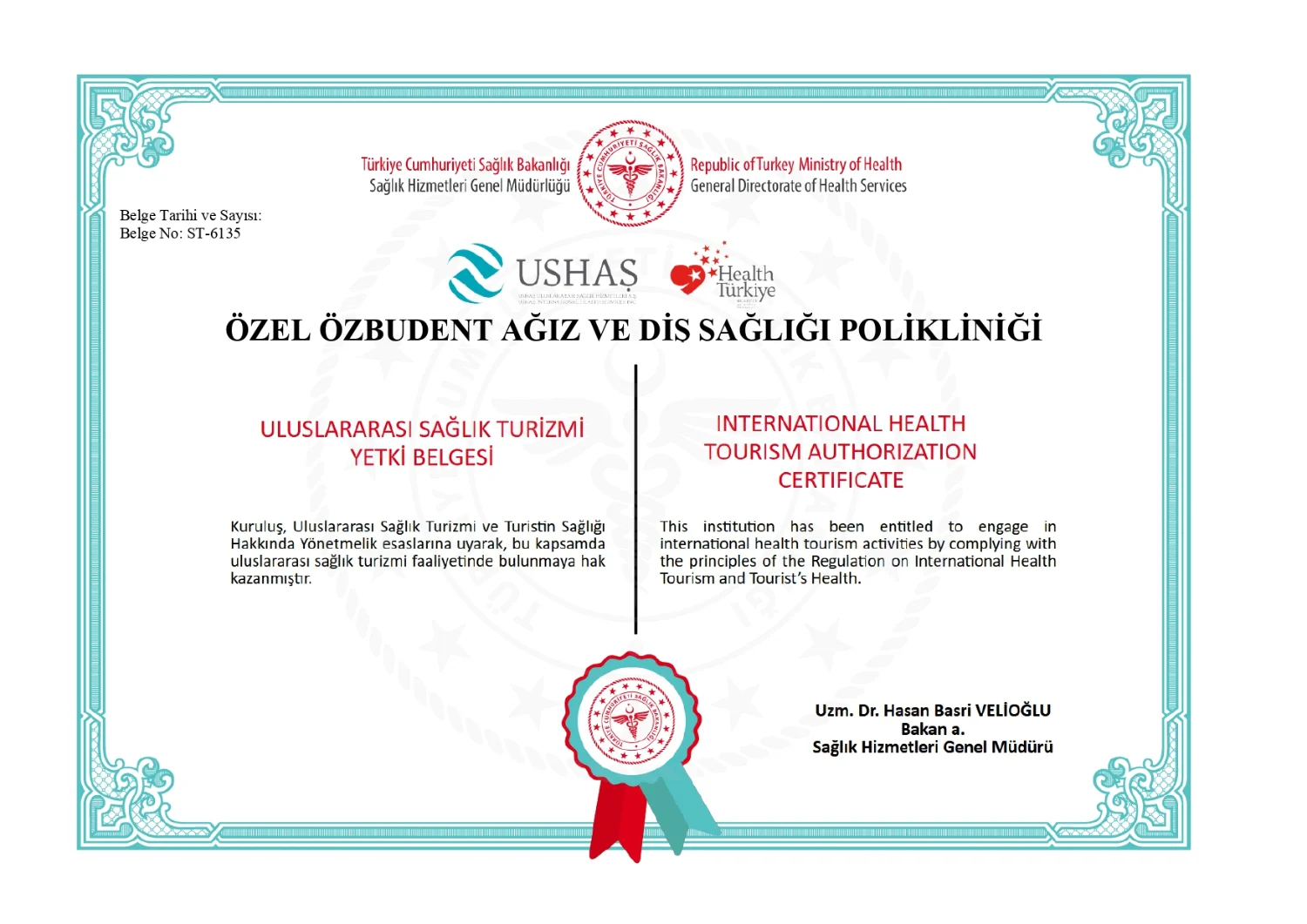

Özel ÖzbuDent Oral and Dental Health Polyclinic holds the International Health Tourism Authorization Certificate, issued by the Republic of Türkiye Ministry of Health under certificate number ST-6135. This certificate shows that our clinic meets the service and quality standards of international health tourism legislation and is officially authorized to serve patients coming from abroad.
Within the HealthTürkiye program, we accompany our international patients end to end — from examination to treatment planning — in implants, cosmetic dentistry and all oral and dental health treatments. Please contact us for detailed information.
You are currently outside our WhatsApp support hours. If you have an emergency, please call us — our clinics are open every day until 03:00. You can still leave your message; we'll get back to you as soon as the line opens.