Standard Root Canal TreatmentMost common
The infected nerve tissue is removed, the canals are shaped and disinfected using rotary instrument systems, and sealed airtight. In most cases, treatment is completed in a single session.
Root canal treatment is a procedure that saves a tooth — rather than extracting it — when advanced decay, trauma, or infection has damaged the dental nerve (pulp). The infected tissue is removed from the inside, the canals are disinfected, and the tooth is sealed with a special filling material. Performed under local anesthesia, it is completely comfortable and eliminates throbbing tooth pain at its source. Root canal treatment is also available at our late-hour branches for dental emergencies.
Inside every tooth is a living tissue made up of blood vessels and nerves, called the pulp. When decay reaches this tissue or a tooth is injured by trauma, the pulp becomes inflamed — this is the cause of intense, throbbing pain that worsens at night. In root canal treatment, the infected tissue is removed, the root canals are disinfected, and they are sealed with a special filling material.
The tooth remains in place — firmly rooted in the jaw with its nerves removed but its roots intact. Unlike extraction followed by an implant or bridge, you continue chewing with your own natural tooth.
Root canal treatment becomes necessary when decay has reached the nerve, when a tooth has prolonged sensitivity to cold or heat, worsening nighttime throbbing, an abscess, or color change following trauma.
No implant or prosthesis can fully replace a natural tooth. When a tooth can still be saved, the first goal is always to keep it in place; extraction is only considered when the tooth truly cannot be saved.
Yes. Pain that subsides on its own usually means the nerve has lost its vitality; the infection silently advances toward the root tip and the surrounding bone. Treatment must be completed without being misled by the pain-free period.
With modern rotary instrument systems and digital imaging, root canal treatment today is a fast, comfortable, and highly successful routine procedure.
The root and body of the tooth are preserved; the sensation of chewing, your bite, and the alignment of neighboring teeth all continue naturally.
Because the infected nerve tissue causing the throbbing pain is removed, the pain is not temporarily masked — it is permanently resolved.
In most cases, treatment is completed in a single session; local anesthesia ensures you feel no pain throughout the procedure.
With a properly performed root canal and appropriate restoration, the tooth can serve you for many years — just like your natural teeth.
The decision is made through examination, X-rays, and tooth vitality tests. The most common situations include:
When decay has progressed through the enamel and dentin to reach the nerve, a simple filling is no longer sufficient; the tooth can only be saved with root canal treatment.
If there is an abscess at the root tip, swelling in the gum, or facial swelling, the source of infection is cleaned from inside the canal; if necessary, treatment proceeds in stages with antibiotic support.
Teeth that have been struck, fractured, or have darkened over time may have lost nerve vitality; these teeth can be both saved and aesthetically restored with root canal treatment.
Root canals performed years ago that are now causing problems can be re-addressed through retreatment; the old filling is removed and the canals are re-cleaned and re-filled.
The approach varies depending on the condition of the tooth and the extent of the infection; the correct method is determined through examination and X-rays.
The infected nerve tissue is removed, the canals are shaped and disinfected using rotary instrument systems, and sealed airtight. In most cases, treatment is completed in a single session.
For previously treated root canals that have failed, the old filling is removed, the canals are re-cleaned and re-filled; the tooth is saved from extraction once more.
When an active abscess is present, the infection is first drained and medication is placed inside the canal; once the infection has subsided, the permanent root canal filling is completed.
For unbearable tooth pain, the tooth's nerve is relieved in an emergency session and the pain is resolved the same day; definitive treatment is completed at follow-up visits. Our branches are open late into the evening.
A controlled, pain-free process in four steps — from initial examination to permanent restoration.
The vitality of the tooth is tested and the root and canal structure is examined by X-ray; the need for root canal treatment is confirmed.
The area is completely numbed with local anesthesia; the tooth is isolated from saliva to create a sterile working environment.
The infected tissue is removed, the canals are shaped and disinfected, and sealed all the way to the root tip.
The crown of the tooth is restored with a filling or crown; the tooth's health is monitored through periodic check-ups.
The longevity of the treatment depends on the care taken during the first few days afterward and on having the permanent restoration completed on time.
Slight sensitivity when chewing is possible for a few days after treatment; it is easily managed with pain relievers recommended by your dentist.
Until the permanent restoration is completed, avoid chewing hard foods on that side; the temporary filling is sensitive to excessive force.
A tooth that has had root canal treatment can become brittle; if the recommended filling or crown is not placed in time, the tooth risks fracturing.
Brushing twice a day, flossing, and periodic dental check-ups extend the life of a root canal–treated tooth as long as your natural teeth.
Don't put off that throbbing pain; let us diagnose it accurately with an exam and X-rays and save your tooth from extraction. Our branches are open late into the evening.
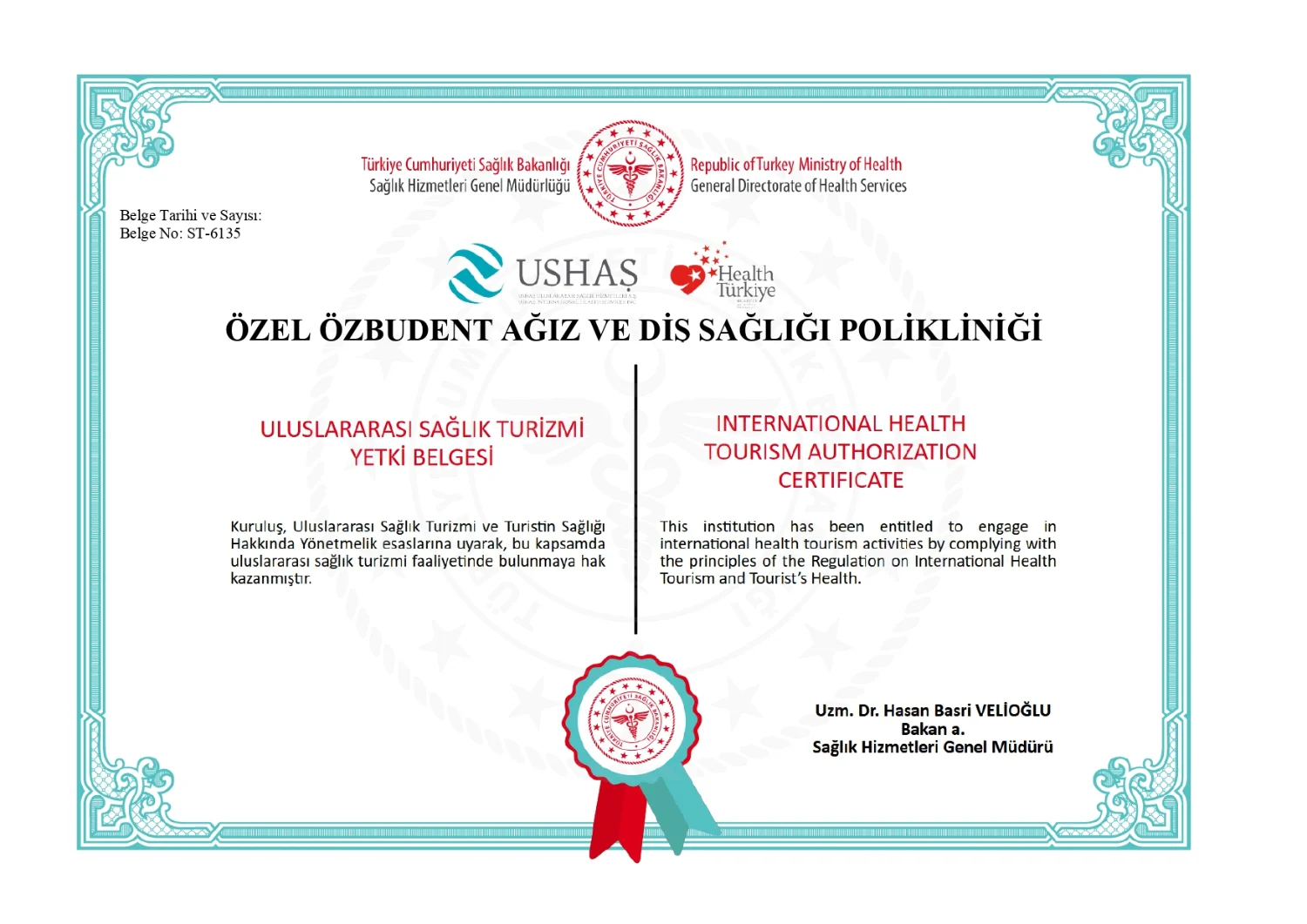

Özel ÖzbuDent Oral and Dental Health Polyclinic holds the International Health Tourism Authorization Certificate, issued by the Republic of Türkiye Ministry of Health under certificate number ST-6135. This certificate shows that our clinic meets the service and quality standards of international health tourism legislation and is officially authorized to serve patients coming from abroad.
Within the HealthTürkiye program, we accompany our international patients end to end — from examination to treatment planning — in implants, cosmetic dentistry and all oral and dental health treatments. Please contact us for detailed information.

You are currently outside our WhatsApp support hours. If you have an emergency, please call us — our clinics are open every day until 03:00. You can still leave your message; we'll get back to you as soon as the line opens.