Fixed Bridge ProsthesisSurgery-free / fixed
A fixed prosthesis supported by the teeth on either side of the gap. It provides near-natural use without the hassle of removal.
Learn moreFrom fixed bridges to complete and partial dentures, and implant-supported snap-on or fixed prostheses — all options are available at ÖzbuDent. We plan the prosthesis that best fits your oral anatomy, expectations, and budget using digital impressions and specialist dentist evaluation.
A dental prosthesis is a custom-made artificial tooth solution that restores the appearance of missing teeth, chewing function, and speech. It is particularly indicated in the following situations:
For patients who are not suitable candidates for implant surgery or who wish to avoid surgery, bridges and removable dentures offer an effective alternative.
In jaws where several or all teeth are missing, complete and partial dentures quickly restore function.
Prosthetic treatment is completed in less time than implant therapy and is more accessible in terms of cost — a practical starting point for many patients.
Patients who feel self-conscious about smiling due to missing teeth regain their aesthetics and confidence with natural-looking prostheses.
Fixed or removable prosthesis options are applied depending on the number of missing teeth, the condition of remaining teeth, and your expectations. We determine the most appropriate type together at your examination.
A fixed prosthesis supported by the teeth on either side of the gap. It provides near-natural use without the hassle of removal.
Learn moreThe classic removable prosthesis applied when no teeth remain in the jaw, replacing all missing teeth. With modern materials it is thinner, more aesthetic, and more comfortable than ever.
Learn moreA removable prosthesis supported by remaining natural teeth when some teeth are still present. With precision attachment options, no metal clasp is visible.
Learn moreA removable prosthesis that locks onto 2–4 implants with a snap system. Far more stable than a conventional full denture — it does not shift, causes no soreness, and lets you chew with confidence.
Learn moreA full-arch fixed prosthesis screwed onto implants that cannot be removed by the patient. The closest feel to natural teeth — the permanent teeth of the All-on-Four concept.
Learn moreThe right prosthesis depends on the number of missing teeth, the strength of remaining teeth, the condition of your jawbone, and your expectations. A brief summary:
A bridge prosthesis can be applied for a fixed solution without surgery; a dental implant is also a permanent alternative worth considering.
A partial denture supported by remaining teeth — or implant-supported options where appropriate — can be planned.
A classic complete (full) denture or, for a far more stable result, an implant-supported snap-on denture is preferred.
An implant-supported fixed prosthesis (All-on-Four) screwed onto implants is the most permanent solution closest to natural teeth.
We are with you at every stage — from your first examination until you are fully comfortable with your prosthesis.
An intraoral evaluation and, where needed, digital imaging are performed to determine the most suitable prosthesis type for you.
A digital or conventional impression is taken; the prosthesis is custom-designed in the laboratory according to your facial proportions and bite.
Color, size, and fit are verified through try-in appointments; the prosthesis is not finalized until you approve it.
The prosthesis is delivered; throughout the adjustment period, soreness and fit checks ensure complete comfort.
Fixed or removable? Implant-supported? Let us determine the best prosthesis option together. Proper planning starts with an examination — and flexible payment options make the treatment process comfortable.
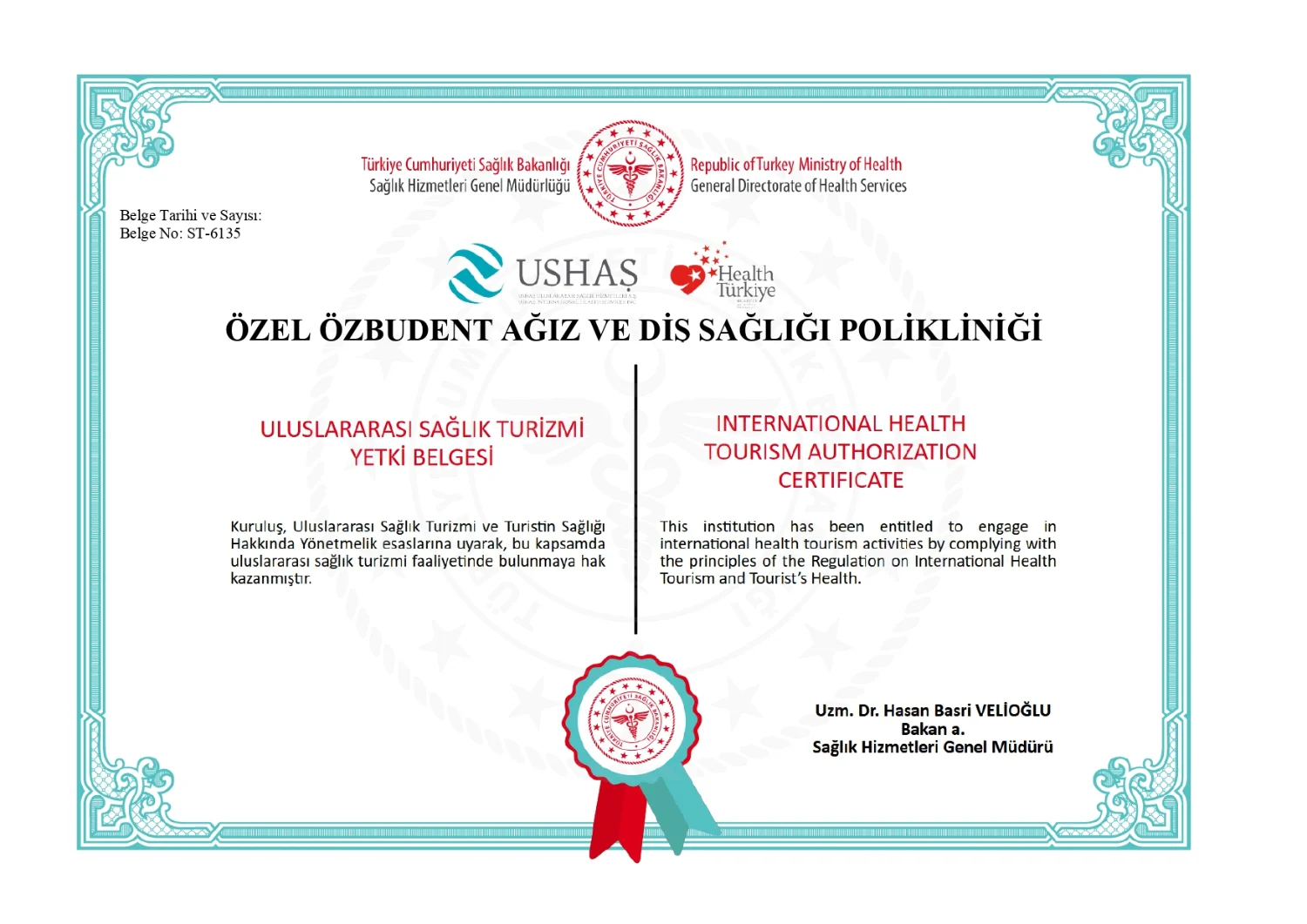

Özel ÖzbuDent Oral and Dental Health Polyclinic holds the International Health Tourism Authorization Certificate, issued by the Republic of Türkiye Ministry of Health under certificate number ST-6135. This certificate shows that our clinic meets the service and quality standards of international health tourism legislation and is officially authorized to serve patients coming from abroad.
Within the HealthTürkiye program, we accompany our international patients end to end — from examination to treatment planning — in implants, cosmetic dentistry and all oral and dental health treatments. Please contact us for detailed information.

You are currently outside our WhatsApp support hours. If you have an emergency, please call us — our clinics are open every day until 03:00. You can still leave your message; we'll get back to you as soon as the line opens.