Fluoride VarnishMost common method
A protective varnish brushed onto the teeth that hardens quickly. Applied under a dentist's supervision in an age-appropriate dose; safe even for infants and young children.
Fluoride application strengthens tooth enamel, making it resistant to decay; fissure sealant seals the deep grooves of molars — the area most vulnerable to cavities — with a thin protective layer. Both procedures require no needles, cause no pain, and are completed in minutes — your child leaves the chair with a smile.
These are two core preventive dentistry treatments. Fluoride (fluoride mineral) is a naturally occurring mineral that strengthens tooth enamel; under a dentist's supervision, it is applied to the teeth in varnish or gel form, making the enamel resistant to acid attacks. Fissure sealant is a fluid, tooth-colored filling material applied to the deep grooves and pits (fissures) on the chewing surfaces of molars, preventing food and bacteria from settling in.
The majority of childhood cavities start in these deep grooves of molars; toothbrush bristles often cannot reach these areas. Together, the two treatments take preventive action before a cavity forms, cause no harm to the tooth, and are globally recognized preventive approaches.
It incorporates into the enamel to strengthen the tooth against acids and helps remineralize early-stage enamel erosion.
It physically seals the deep grooves of molars with a thin layer, leaving no surface for bacteria and food debris to cling to.
A filling involves cleaning and filling an existing cavity; a sealant is applied to a healthy tooth — no drilling or scraping is done — it is entirely preventive.
Preventive treatments are far simpler, more comfortable, and more cost-effective compared to procedures such as fillings or root canal treatment that may be needed later. Having a child's first dental experience be pain-free also lays the foundation for a lifetime of healthy care habits.
The deep grooves where cavities most commonly begin are sealed and enamel is strengthened — action is taken before a problem develops.
No drilling, scraping, or anesthesia; healthy tooth structure is preserved entirely intact.
Short, painless, and non-frightening sessions help children build a positive relationship with the dental chair.
Every cavity prevented eliminates the future need — and cost — of fillings, root canal treatment, or extractions.
While these treatments are primarily aimed at children, they can be planned for patients of any age who carry a risk of cavities. Which treatment to perform and how often is decided based on the individual cavity risk assessed at the examination.
Fluoride application for high-risk children begins during the baby-teeth stage; sealants can also be applied to primary molars when deemed necessary.
The first permanent molars erupt around age 6 and are at their most cavity-prone stage; this is the ideal time for fissure sealant.
Patients who have frequent cavities, wear braces, or experience dry mouth benefit from regular fluoride as part of a preventive program.
Fissure sealant can also be applied to adults with deep grooves in their molars; the protective benefit is not limited by age.
Based on the cavity risk determined at the examination, treatments are planned individually or together as a personalized protection program.
A protective varnish brushed onto the teeth that hardens quickly. Applied under a dentist's supervision in an age-appropriate dose; safe even for infants and young children.
A gel or foam placed in custom trays and held against the teeth for a short time; preferred for cooperative older children and adults.
A fluid filling material is applied to the deep grooves on the chewing surfaces of molars and light-cured in seconds; the surface becomes smooth and easier to clean.
A personalized plan combining regular check-ups, cleanings, fluoride renewals, and sealant monitoring; the entire family's dental health is tracked in one program.
Both treatments are completed in a single session, in a short time, and entirely without pain.
The teeth are checked and cavity risk is evaluated; the dentist determines which teeth will receive which treatment.
The surfaces of the teeth to be treated are gently cleaned and dried; for sealant, the grooves are prepared with a special gel.
Fluoride varnish is applied with a brush; fissure sealant is flowed into the grooves and light-cured in seconds.
The bite is checked; sealants are reviewed at regular check-ups and fluoride is renewed as needed.
Preventive treatments place no restrictions on daily life; simply following a few easy guidelines and attending regular check-ups is enough to maintain their effectiveness.
After fluoride varnish, eating and drinking is paused briefly; avoiding hard and sticky foods for the rest of that day is all that is needed.
These treatments do not replace brushing; twice-daily brushing with fluoride toothpaste and regular flossing should be maintained.
Fissure sealants last for years; any worn or partially lost areas are noticed at regular check-ups and can be easily touched up in the same visit.
The effect of fluoride application is not permanent; renewal every 3–6 months is generally recommended based on cavity risk.
Let's take action before cavities form. At your examination, we'll assess cavity risk together and design a personalized preventive care program for your child and your whole family.
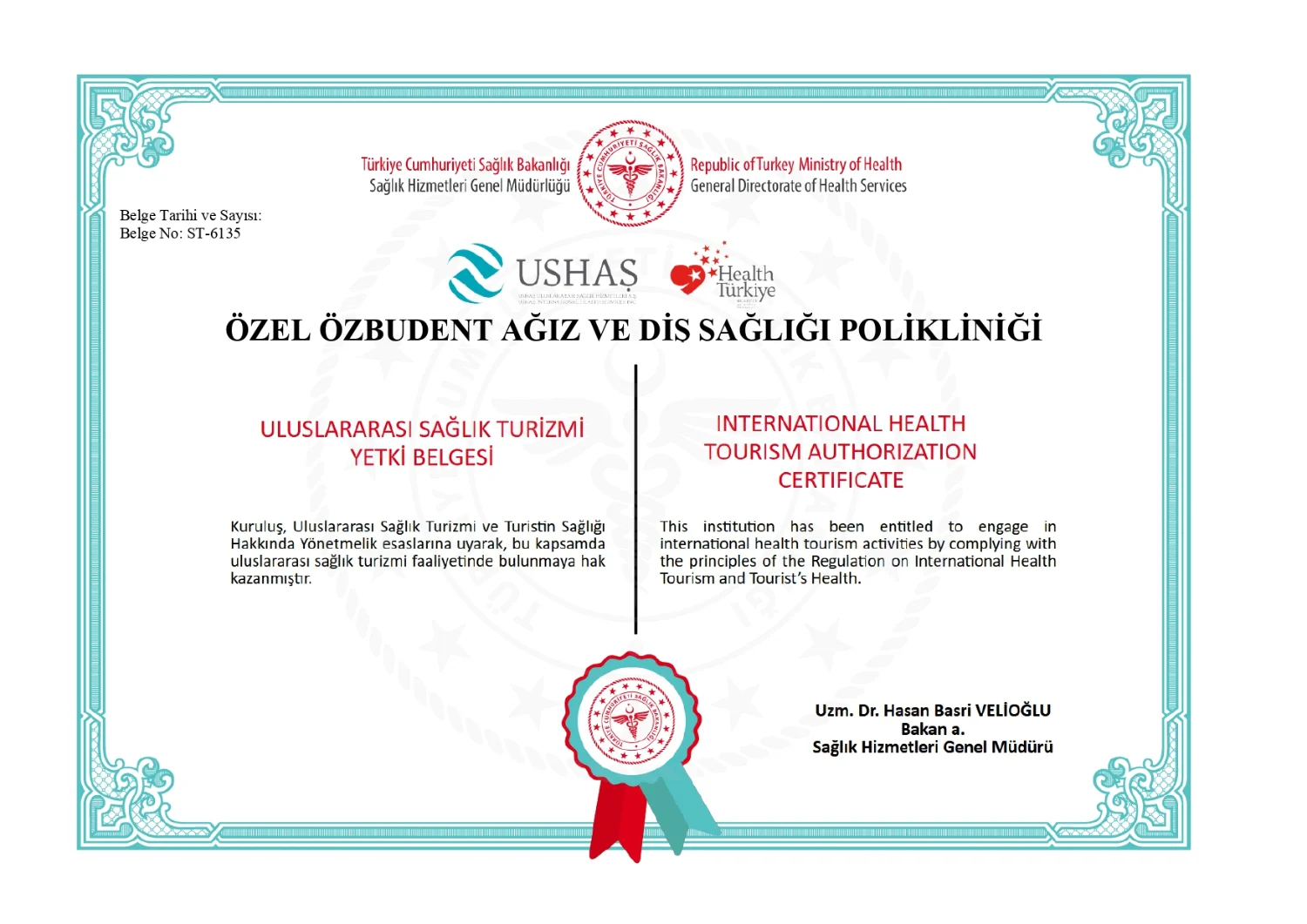

Özel ÖzbuDent Oral and Dental Health Polyclinic holds the International Health Tourism Authorization Certificate, issued by the Republic of Türkiye Ministry of Health under certificate number ST-6135. This certificate shows that our clinic meets the service and quality standards of international health tourism legislation and is officially authorized to serve patients coming from abroad.
Within the HealthTürkiye program, we accompany our international patients end to end — from examination to treatment planning — in implants, cosmetic dentistry and all oral and dental health treatments. Please contact us for detailed information.

You are currently outside our WhatsApp support hours. If you have an emergency, please call us — our clinics are open every day until 03:00. You can still leave your message; we'll get back to you as soon as the line opens.