Metal BracketsStandard · most durable
The most widely used and most durable system. Modern small-profile metal brackets offer excellent force control and are the first choice for advanced cases.
Braces (fixed orthodontic treatment) gradually move crowded, spaced, or misaligned teeth into their ideal positions using brackets and arch wires — orthodontics' most established and most predictable method. We plan your treatment around your lifestyle with metal, ceramic, and lingual options.
Braces are a fixed orthodontic treatment that moves teeth gradually through the bone using gentle, continuous forces applied by brackets bonded to the tooth surfaces and arch wires threaded through them. They correct crowding, spacing, forward inclination of front teeth, and upper-to-lower jaw bite problems.
Braces have the longest clinical track record in orthodontics; even in complex and advanced cases, tooth movement remains fully under the dentist's control. Because brackets stay fixed to the teeth throughout treatment, results do not depend on the patient's compliance with wearing a removable appliance.
The gentle force of the arch wire triggers controlled remodeling of the bone around the tooth root, allowing the tooth to advance month by month toward its planned position. This is a natural biological process.
Clear aligners are removable and nearly invisible; braces are fixed and under continuous clinical control. For advanced crowding and bite problems, braces often deliver more predictable outcomes.
Crowded teeth make brushing difficult, creating conditions for cavities and gum problems; bite misalignment places stress on the jaw joint. Early correction both shortens treatment time and prevents complications.
Decades of use and the best-documented outcomes in orthodontics make braces the first choice — especially for moderate and advanced cases.
Applicable to crowding and bite issues ranging from mild to severe; tooth movement is fully under the dentist's control.
No cutting or crowns required; teeth move to their new positions in a healthy, natural way while preserving their own structure.
Properly aligned teeth are easier to clean, reducing the risk of cavities, gum disease, and jaw joint problems while improving bite balance.
Because brackets remain on the teeth throughout treatment, results do not depend on appliance-wearing discipline; treatment progresses exactly as planned.
Braces can be applied to patients of all ages whose teeth and gums are healthy; the right timing and method are determined during the consultation.
The most common reason for braces. Teeth are moved to their ideal alignment with or without extractions, depending on the case.
For conditions such as an overjet, underbite, or open bite, the jaw-to-tooth relationship is corrected using wires.
Tooth movement is faster while the jaw is still developing; the ideal treatment window is usually early adolescence, once the mixed dentition phase is complete. An early evaluation helps guide timing.
Tooth movement is possible at any age; treatment may take somewhat longer in adults. Ceramic and lingual bracket options are available for those concerned about appearance.
We work with you to choose the bracket system that best suits your case requirements and aesthetic expectations.
The most widely used and most durable system. Modern small-profile metal brackets offer excellent force control and are the first choice for advanced cases.
Ceramic brackets closely match tooth color and are barely noticeable from a distance; they work on the same principle as metal. A popular choice for appearance-conscious adults.
A system that holds the wire inside the bracket with a built-in clip rather than elastic ties, reducing friction, potentially lengthening the interval between appointments, and making hygiene easier.
Brackets are bonded to the inner (tongue-side) surface of the teeth and are invisible from the outside. Planned specifically for cases where no visible hardware is desired.
A planned, closely monitored journey from your initial consultation to wire removal and long-term retention of your smile.
An oral examination, X-rays, and digital measurements are used to analyze your tooth-jaw relationship and clarify whether treatment is needed and which options suit you.
The bracket type, estimated duration, and any extraction needs are planned; the process and expected outcome are explained to you clearly.
Brackets are bonded to teeth in a single session and the arch wire is attached; at check-ups every 4–6 weeks, wires are progressively updated.
Once the target position is reached, brackets are removed; a retainer is fitted to prevent teeth from shifting back, and follow-up is maintained.
Whether treatment finishes on schedule and in good health depends on the daily care you give while wearing braces.
Brushing after every meal, combined with an interdental brush and orthodontic floss around the brackets, prevents cavities and staining.
Nuts, hard-crusted bread, chewing gum, and caramel can break brackets off; hard fruits like apples should be cut into slices before eating.
Wire updates are the engine of treatment; every missed appointment extends total treatment time. Report a broken bracket as soon as possible.
After wires are removed, wearing your retainer determines how long-lasting your results are; use it for the duration and frequency your dentist recommends.
Let's find the right bracket system and treatment plan for your teeth together. A precise diagnosis through examination and digital analysis, followed by a closely monitored process with scheduled check-ups.
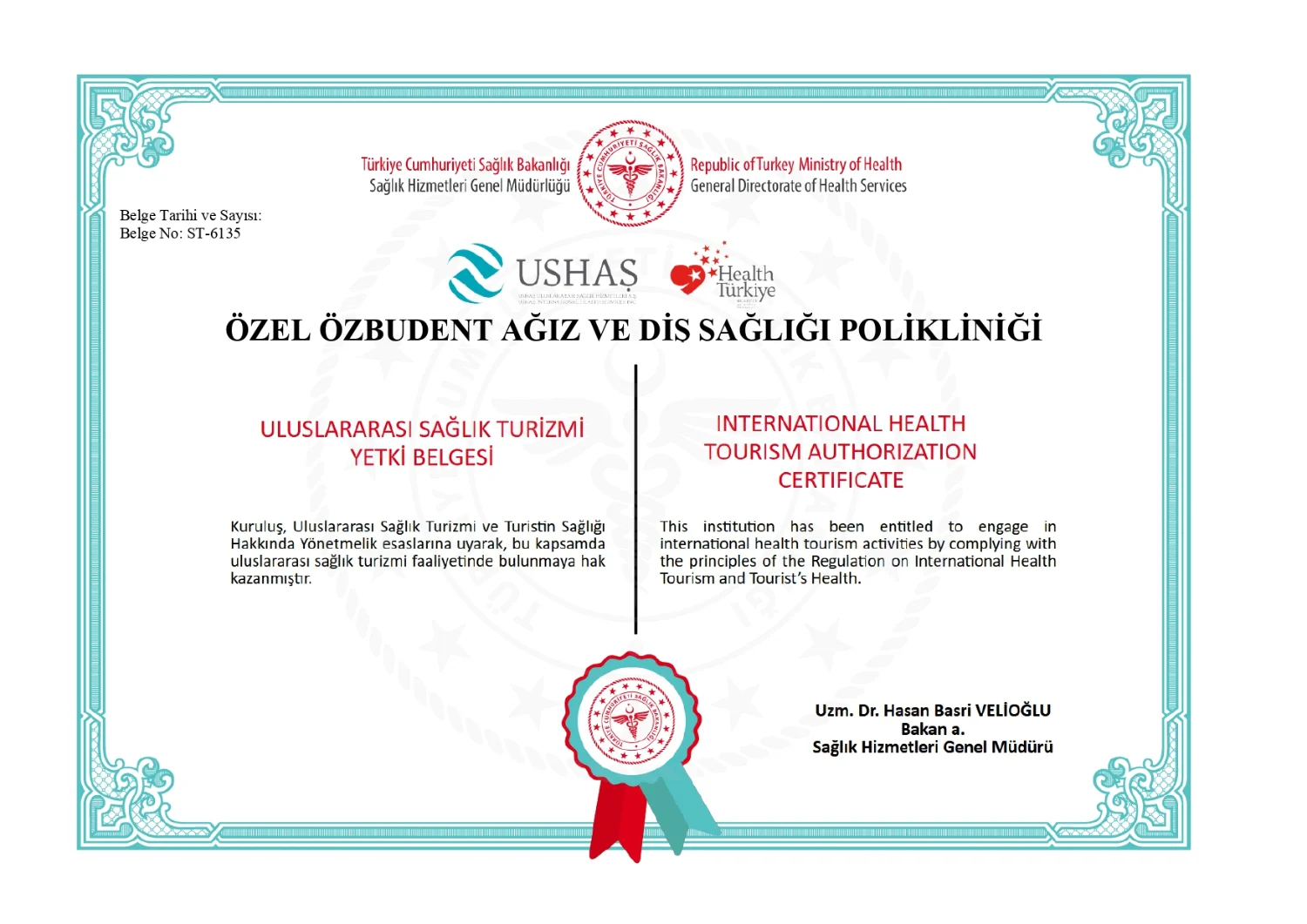

Özel ÖzbuDent Oral and Dental Health Polyclinic holds the International Health Tourism Authorization Certificate, issued by the Republic of Türkiye Ministry of Health under certificate number ST-6135. This certificate shows that our clinic meets the service and quality standards of international health tourism legislation and is officially authorized to serve patients coming from abroad.
Within the HealthTürkiye program, we accompany our international patients end to end — from examination to treatment planning — in implants, cosmetic dentistry and all oral and dental health treatments. Please contact us for detailed information.
You are currently outside our WhatsApp support hours. If you have an emergency, please call us — our clinics are open every day until 03:00. You can still leave your message; we'll get back to you as soon as the line opens.