Fully Custom Lingual SystemMade-to-measure
Brackets fabricated from digital scans and fitted precisely to the inner surface of each tooth — the most comfortable and accurate lingual approach, with a shorter adaptation period.
With lingual orthodontics, brackets are placed on the inner (tongue-facing) surface of the teeth. No one will notice you are undergoing orthodontic treatment while you smile or speak. We correct crowding and bite issues under close clinical supervision — without affecting your social or professional life.
Lingual orthodontics is a fixed brace system in which brackets and wires are bonded to the tongue-facing (lingual) inner surface of the teeth rather than the front surface. Teeth are moved with the same controlled forces used in conventional orthodontics — the only difference is that the entire system works on the side that is completely hidden from view.
In most cases the brackets are digitally planned from precise scans and positioned to match the individual anatomy of each tooth's inner surface. This approach is one of the most popular invisible orthodontic options for adults who do not want to compromise their appearance throughout treatment.
The mechanics are identical; the difference is that the brackets are placed on the inner surface of the teeth. This delivers the full treatment effectiveness of fixed braces while remaining invisible from the outside.
Yes. Because the brackets stay behind the teeth, they are undetectable from the outside while smiling, speaking, or in photos — they are visible only when looking directly inside the mouth.
Clear aligners are removable, while lingual braces are fixed; they work continuously regardless of patient compliance and give the dentist precise control over more complex tooth movements. Which option is right for you is determined at your examination.
Invisibility is not the only benefit — being a fixed, fully customized system adds clinical strength to the treatment as well.
Because the brackets remain behind the teeth, no one will know you are wearing braces — in job interviews, on camera, or in everyday social situations.
The fixed bracket system delivers precise tooth movement across a wide range of cases, from crowding to bite discrepancies.
Using digital scans and individually positioned brackets, treatment is designed to match the unique anatomy of each tooth's inner surface.
Because no brackets are bonded to the visible front surfaces of the teeth, those surfaces are preserved in their natural state throughout treatment.
Lingual braces can be applied to virtually any adult or young individual with healthy teeth and gums who needs orthodontic treatment. Suitability is confirmed at the examination and digital scan.
For those who do not want to compromise their appearance during treatment, lingual braces are the most invisible fixed treatment option available.
In highly visible professions such as presenting, acting, or instructing, orthodontic treatment can be completed without anyone noticing.
Crowding, spacing, and many bite irregularities can be corrected with a lingual system at the same effectiveness as conventional braces.
Very short tooth height, untreated advanced gum disease, and certain deep-bite cases may make lingual bracket placement unsuitable; in those situations your dentist will plan alternative invisible options.
Based on your needs, the scope of your case, and your expectations, the most suitable lingual approach is chosen together.
Brackets fabricated from digital scans and fitted precisely to the inner surface of each tooth — the most comfortable and accurate lingual approach, with a shorter adaptation period.
Pre-made lingual brackets positioned on the inner surfaces of the teeth by the dentist; provides effective invisible treatment for suitable cases.
When the problem is limited to the upper or lower arch only, the lingual system is applied to a single arch, reducing both the scope and duration of treatment.
In some cases lingual brackets are combined with other invisible options such as clear aligners to create the most balanced plan in terms of duration and comfort.
A controlled four-step process, from digital planning through to the retention phase.
Tooth movements are planned using an intraoral examination, X-rays, and digital scans; the target smile is established from the outset.
Based on the plan, brackets are custom-positioned for the inner surface of each tooth; in fully customized systems they are fabricated in a dental laboratory.
Brackets are bonded to the inner surfaces and wires are fitted; tooth movement is guided step by step at regular check-up appointments.
Once the wires are removed, a retainer is worn to keep the teeth in their new positions.
After a brief adaptation period treatment becomes a natural part of daily life; attentive care helps speed up your results.
During the first 1–2 weeks there may be mild sensitivity in the tongue and a temporary change in speech; the tongue adapts to the brackets within a short time.
Because the inner surfaces of the teeth are not easily visible, the use of an interdental brush and a water flosser in addition to regular brushing is recommended.
Very hard and sticky foods can put stress on the brackets; such foods should be avoided throughout treatment.
Attending scheduled adjustment appointments consistently ensures that treatment is completed on time.
Let us assess together whether lingual braces are the right option for you. A thorough examination and digital planning will provide a clear roadmap and a treatment process that never compromises your appearance.
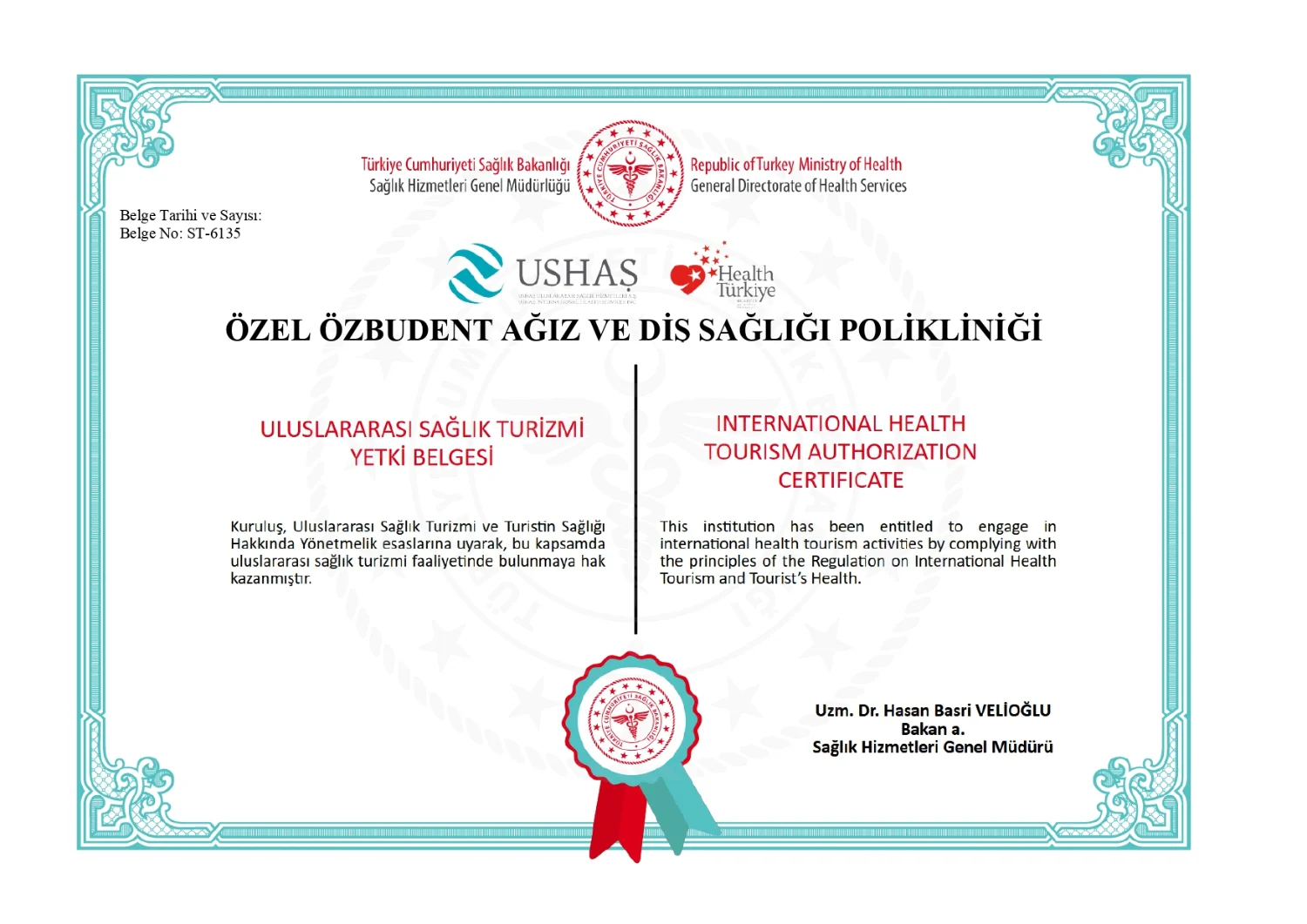

Özel ÖzbuDent Oral and Dental Health Polyclinic holds the International Health Tourism Authorization Certificate, issued by the Republic of Türkiye Ministry of Health under certificate number ST-6135. This certificate shows that our clinic meets the service and quality standards of international health tourism legislation and is officially authorized to serve patients coming from abroad.
Within the HealthTürkiye program, we accompany our international patients end to end — from examination to treatment planning — in implants, cosmetic dentistry and all oral and dental health treatments. Please contact us for detailed information.
You are currently outside our WhatsApp support hours. If you have an emergency, please call us — our clinics are open every day until 03:00. You can still leave your message; we'll get back to you as soon as the line opens.